
Real Talk: LRADs at Protests and How to Reduce Harm

I want to explain why I went down this rabbit hole.
Because LRADs — Long Range Acoustic Devices — are now being used at constitutionally protected protests, including here in Minnesota, I spent hours trying to understand what people are actually dealing with when one of these things is deployed.
That meant watching video footage.
Reading court rulings.
Digging into medical and acoustic research.
And yes — reading firsthand accounts from people who’ve been on the receiving end of them.
I wasn’t looking to sensationalize this. I was looking for one thing:
If you’re anywhere near an LRAD, what actually helps reduce harm?
Before we get there, you need some context. Because once you understand what an LRAD was built to do, its use at protests becomes much harder to ignore.
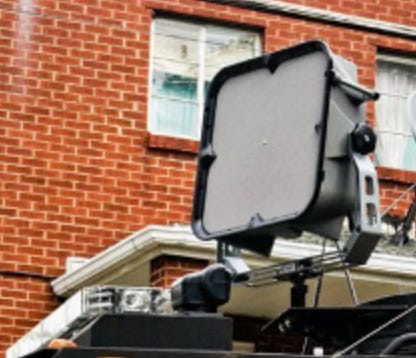
What an LRAD Is — and What It Was Never Meant to Be
LRADs were not designed for protests.
They were not designed for crowd control.
And they were not designed for use on civilians packed into city streets.
They were developed in the early 2000s by American Technology Corporation, now Genasys Inc., for military and maritime defense.
After the 2000 bombing of the USS Cole, the U.S. military identified a serious gap: ships needed a way to warn and deter approaching boats from far away without immediately resorting to gunfire.
So LRADs were designed for open-air, over-water use.
Not underwater. Not sonar.
Sound moving through air, across water — highly directional, extremely loud — so a ship could issue warnings or force distance before a situation escalated into violence.
That original purpose matters, because it tells you something important:
These devices were built to keep threats far away, not to be used up close on civilians.
How LRADs Actually Work
LRADs operate in two basic modes.
The first is communication.
They can project clear, intelligible speech up to about 29,000 feet under ideal conditions — far beyond what normal loudspeakers can do.
The second is deterrence.
In that mode, an LRAD emits a narrow, focused beam of sound that can reach up to 162 decibels at the source.
For reference, prolonged exposure above roughly 120 decibels can cause pain and hearing damage. Higher levels increase the risk of disorientation, nausea, tinnitus, and potentially permanent hearing loss — depending on how close you are and how long you’re exposed.
On the open ocean, that deterrent function was meant to create distance.
At protests, it does the opposite.
How We Got Here
LRADs didn’t suddenly appear at protests overnight. But their use accelerated sharply during the 2020 George Floyd protests.
Across the country — including in places like Portland — law enforcement mounted LRADs on vehicles and used them to disperse crowds. These crowds often included non-violent demonstrators, journalists, and legal observers.
People exposed reported ear pain, dizziness, nausea, vomiting, and lingering hearing problems — sometimes after very brief exposure.
What matters is this:
That use didn’t stop after 2020.
It normalized.
From 2024 through early 2026, LRADs have continued to show up at protests nationwide. In Minnesota, they’ve been deployed during immigration-related protests tied to ICE operations, including in the Minneapolis area.
There is video showing close-range use to clear protesters outside hotels housing federal agents.
That detail matters, because courts have already warned that proximity and intent are key factors in determining whether LRAD use crosses into excessive force.
If you made it this far in the post, congrats, your the kind of person who is actually trying to understand what’s going on. Please share this with anyone who may find themselves in this situation at a protest to keep them safe. We have to take care of each other out here. Please subscribe for updates.
Now, let’s talk about what the courts have said.
What the Courts Have Already Said
The Supreme Court hasn’t ruled directly on LRADs.
But federal appellate courts have — and their message is not subtle.
In Edrei v. Bratton (2018), the Second Circuit Court of Appeals ruled that intentionally using an LRAD in a way that can cause serious injury — including hearing loss and neurological symptoms — can qualify as excessive force under the Fourteenth Amendment.
The court rejected the idea that calling a device “non-lethal” gives it a free pass.
What matters is proportionality, intent, and foreseeable harm.
That ruling was reaffirmed in 2021.
In plain language:
If you deploy these devices recklessly, the Constitution still applies.
The Health Risks Are Real
Medical and acoustic experts have been warning about this for years.
Reported effects of LRAD exposure include:
immediate pain and pressure
disorientation and nausea
ringing in the ears
temporary or permanent hearing loss
Because LRADs function like a spotlight — a narrow, directional beam — people directly in front of them experience far greater exposure than people only a few steps to the side.
That detail is important, because it tells us what actually helps.
What Actually Helps Reduce Harm
There’s no perfect protection here.
And the safest option is always to leave the area calmly and as soon as you can.
That said, a few things consistently come up in expert guidance and real-world experience.
Move sideways, not straight back.
LRADs are directional. Stepping laterally — to the side — gets you out of the beam far faster than backing away in a straight line.
Use distance and solid barriers.
Sound intensity drops quickly with distance. Buildings, walls, vehicles, or other dense objects can partially block or deflect sound. You may even use your protest sign in front of your head to reduce the impact. If you turn the matte side towards the LRAD, it will absorb the sound, if you turn the glossy side towards the LRAD, it will reflect the sound back in the direction of the LRAD.
Layer hearing protection when possible.
Experts often recommend combining high–Noise Reduction Rating earplugs with over-ear earmuffs. Layering protection is more effective against sustained, high-decibel sound than using either alone.
These are the two that I have ordered for double protection based on my research.
Inner Ear-$10: https://amzn.to/3Z8GqFR
Outer Ear-$18: https://amzn.to/4bWHPqr
(Both Linked at the top of AskRaphaela.com Under ‘Protect Against LRAD At Protests.)
**This will make the sound bearable and reduce the risk of hearing damage, but the high decibel will still make you feel disoriented. This is simply to protect your hearing long term if they deploy this device near you.
Pay attention to symptoms afterward.
Ringing, pain, dizziness, or nausea are signs you should seek medical evaluation.
None of this makes LRADs “safe.”
But it can reduce harm.
The Bigger Issue
LRADs sit in an uncomfortable gray area between communication and force.
They were designed to prevent violence at a distance.
Now they’re being used up close on civilians exercising basic constitutional rights.
Courts have already raised red flags.
Health experts have already documented the risks.
So the real question isn’t whether LRADs are powerful — we know they are.
The question is whether this is a line they are comfortable crossing.
I think we all know the answer to that. Stay safe out there.
Video Version: